
Reviewed By: Faahid Shoukat Ali
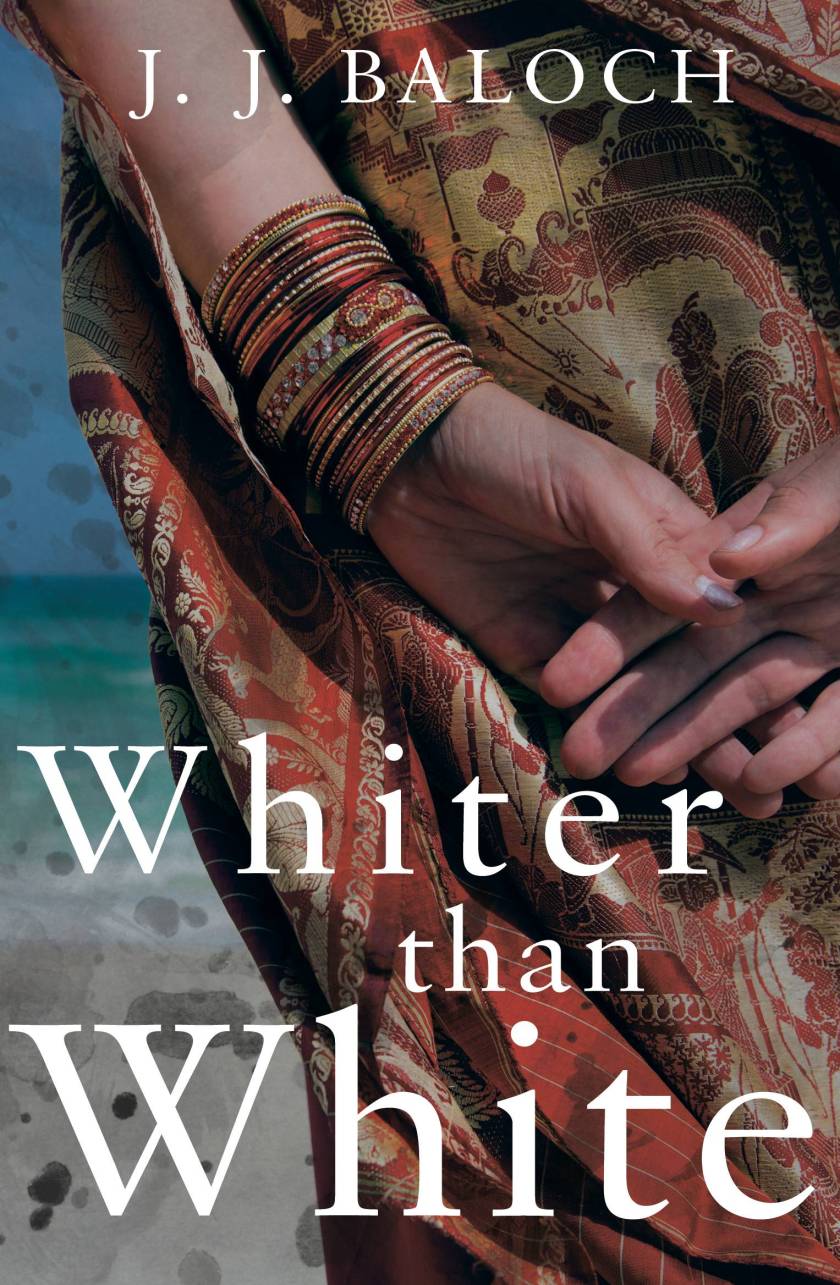
It was just by chance that I happened to come across J. J. Baloch’s novel Whiter than White at one of the posh bookshops (Liberty Books) of Karachi. Its revealing title page attracted me in the first place and then I hurriedly skimmed through the novel, to get an idea about its theme. I admit that once I started reading the novel, I could not take it off my mind for a moment (even during the time when I was not reading it) and finished it in just two days’ time.
2. Whiter than White is a scathing criticism of the gender bias against women that is firmly entrenched in our culture, traditions, policing, jailing and criminal justice system. The writer, a senior police officer of sterling professional credentials, has got to the heart of the reality and exposed the seamy side of the system that treats woman nothing more than an article of daily use. J J Baloch has created a very powerful novel out of what sounds like a mundane theme. His graphics and captivating depiction of the routines and realities of our life reminds the reader of the tradition of realism in modern British drama that started with John Osborne’s famous play Look Back in Anger, which was staged on 8th May 1956 in London’s Broadway Theatre for the first time. No reader can miss the pronounced tinge of verisimilitude that pervades the novel from beginning to the end.
3. Hoor, the heroine of the novel, suffers immensely at the hands of the inherently hostile system and its cruel custodians. And the result is a heart-curdling tale of trials and tribulations. She is a frail person, but only in terms of her physique. By no means does she give an impression of frailty in the sense in which Shakespeare meant it in his frequently quoted phrase in Hamlet – “Frailty, thy name is woman”. Shakespeare’s hero laments feebleness of female character in the context of his mother’s involvement in the killing of his father in a bloody display of power politics. Clearly, Shakespeare’s idea of frailty, in the context of Hamlet, is pretty inclusive: it includes not only the lack of physical strength that women folk are heir to but also the weakness of moral and psychological nature as well. However, J. J. Baloch’s heroine presents a complete contrast to the Shakespearean depiction of
4. woman in Hamlet. Hoor is beautiful in the body as well as in soul in the best of proportions. Her beauty of body and soul is very well supplemented by the immense courage and God-gifted mental strength. All these components combine together into an exquisite whole, to enable her to conquer everyone she comes across: she is the embodiment of Truth, in the sense that John Keats describes it – “Beauty is Truth, Truth Beauty.” Her valiant character comes to her rescue quite often during the novel. However, besides adding spice to the story, the novelist has used all these events and incidents (displaying her courage) as a characterisation technique. She is even more courageous than Jibraan Khan, the great feminist writer and women rights activist who not only fights successfully for Hoor’s release and introduces her to the world at large but also marries her. For example, when she and her newly-wedded husband are on the plane to flee the country with a view to avoiding life threat received from a terrorist outfit, she does not mince words and tells him categorically: “Don’t you think we are cowards, who are leaving their homeland to escape death which could catch us anywhere anytime, even on this plane? Do we presume that a miracle will happen in our country and angels will descend from above to bring our country back on track? Thus, even death cannot deter her from the principled stance she has on priorities in life.
5. Whiter than White also carries a message, like most world-class pieces of literature, do – for example, nearly every novel written in the 18th century in England entails a message. J J Baloch does identify a serious social malaise of our society (that is, gender bias against women) but he does not leave the reader in a state of helplessness and despondency: instead, he also suggests, with the subtle touch of a great artist, the solution to that problem. And, interestingly, the solution, in essence, lies within the women discriminated against: they need to know their strengths by continuous introspection and prepare themselves mentally to face even the worst moments in life and retain their innocence in all situations and at all cost. Alexander Pope, the famous 18th century English poet, succinctly puts this phenomenon as “Know thyself” in one of his universally remembered poems. Clearly, Hoor has risen in life owing to self-knowledge and recognition of her strength as a woman through continuous soul searching. If other women measure knee-high to Hoor in terms of introspection, self-knowledge, courage, mental toughness and strength (albeit a Herculean task in the context of our social milieu) their woes would not take long to vanish.
6. Whiter than White is the superb exhibition of J. J. Baloch’s art of characterisation. He has used a couple of popular literary techniques to reach the innermost recesses of his characters. One can literally feel the heroine walking across the pages of the novel, situation after situation. Soliloquy is the principal literary technique that the novelist has used to put the inner selves of his character in front of the reader. Hoor’s soliloquies lay bare, shade by shade and layer by layer, the hypocrisies that afflict our society and its “man-made system”, as the novelist puts it frequently. This is reminiscent of Hamlet’s famous soliloquies: Hoor and Hamlet bear striking resemblance in that. Symbolism is the other literary technique that the novelist has employed for portrayal of his characters. The title of the novel, for example, symbolises innocence, flawlessness and perfection. It explains all that Hoor stands for, as Jibraan Khan explains: “Whiter than White is an English idiom or idiomatic expression which is used as an adjective and which means innocent, clean, flawless, perfect and pure.” This symbol looms large all over the novel. In another context, the jail doctor says “I believe and have studied that more than 60% of inmates who are sent to jail are whiter than white and are victimised by our own follies.” Even lesser characters such as Meeral, the villain, and Rohi, the rich and powerful lady whom Hoor befriends during short sojourn of the former in jail and who orchestrates Hoor’s early exit from jail receive quite a bit of J J Baloch’s attention in terms of characterisation.
7. All in all, Whiter than White is J. J. Baloch’s magnum opus that not only portrays the plight and pain of the disadvantaged woman of the Pakistan of our times but also suggests a way forward to her out of this apparent impasse. And it may well be a great idea to render the novel into a film, to get J J Baloch’s message far and wide.
The writer is a graduate of Warwick Business School and currently, serves in the Federal Investigation Agency. He can be reached at faahidali@gmail.com.

 Vision-Vista of JJ Baloch