Our Criminal Justice Dilemma

J. J. BALOCH

criminal-justice


The dilemma in Pakistan’s criminal justice system is deep-rooted and widespread in our societal structure, political traditions, statutory ethos, popular apathy, and institutional turf wars. An autopsy of our criminal justice reveals in an unmistakable way the long list of factors that go uninterrupted in haunting everyone including the public, media, academia, politics and governance.

The form and structure of the state, the modes of its governance and the fundamental paradigm of its regulatory regimes always reflect the essence of society’s culture. However, the human culture is the most ancient and the most powerful influence on human thinking about the perspectives of living and of the moving spirit behind the civilisation.

Ours is, indeed, an outlived criminal justice system; it is incapacitated to live up to the changing times. Our criminal justice fails to be at par with challenges triggered by the age of terror, borderless world, human rights, rule of law, due process of law, age of digits and many similar influences.

The elitist power culture is the core issue in addressing the very fundamental irritants in our criminal justice system. The elitist ethos of our societal structure represented by feudal mindsets and nuisance gamers continue to pre-empt all progressive reform efforts of all our enlightened statesmen. All those who matter because of their ascribed status whether they hail from any segment or interest group ranging from politics, statecraft, bureaucracy, media, civil society, landed gentry leave no stone unturned to perpetuate their status quo to the extent of converting all public interests into their personal and private businesses interests. The common man is yet to attain freedom which is mortgaged in the contours of dynastic democratic tradition in our country.

Political Interference in public department’s especially criminal justice institutions is another problem area. In Pakistan, the entire criminal justice system has been adversely affected by politically motivated policies and practice designed to weaken its structure. Those public servants who maintain the integrity and resist tooth and nail to deny dancing to the tunes of politicians and all others who one way or the other matter in the power structure in Pakistan are either transferred or removed from the service through engineered allegations and concocted departmental enquiries.

As a consequence, the criminal justice system has lost public confidence as a trustworthy and reliable mechanism to redress the public grievances on basis of merit. Many surveys conducted by independent groups and human rights commission of Pakistan time and again testify the fact that 80% of Pakistani Public have no confidence in CJS institutions and believe that they serve regime and protect the powerful lot only. There has reportedly been serious rule of law issues.

We also lack in criminal justice policy principles. It works unsystematically. The idealistic core of the system is dry and hollow within.  The policy for CJS is important and considered as the best practice to enforce the law, ensure justice and maintain public peace and order. Such ideals of the policy are the absolute wasteland in Pakistan where, unfortunately, ad-hoc measures reign supreme, fitting the elitist scheme of things.

Our CJS is yet to adopt the technology. The technology deficit takes our system to nowhere but to the perpetual and utter state of stagnancy and retrogression. The proper use of modern technology of forensics, telemetry, biometrics, digitalism, database formations, and documentation is missing. Its approaches are doubt-driven and not evidence-based.

Sadly to say, we are yet to think of CJS innovations that have been taking place worldwide in last three decades. In order to rise equal to the burgeoning challenges of crime and justice, expanding mandate of CJS institutions specially the gatekeepers -the police, and also rising public expectations within promising democracies, the governments of modern day are left with very thin choices to ignore exploring new ways of reviewing the basic missions of police, their core strategies, and the relationship of police with the community they are sworn to serve.

Despite a number of CJS committees and commissions constituted time and again in 70 years of our country’s age had very insightful and remarkable ideas of renovating CJS but regrettably all withered away in the serious storms of vested interests of bureaucratic and political nature? The most outstanding, to name a few, has been the Police Order 2002 which too saw the light of the day during Musharaf’s autocracy got infected with bureaucratic dengue virus in Punjab and political HIV in Sindh and Balochistan.

Lovely, the democratic ideals and rule of law culture spread in our country in 21st century bring the military-clone democratic order of Musharaf to its logical end in a peaceful manner yet the ill-panned and unregulated advancements resulted out of judicial activism brought the CJS institutions in the crossfire of judicial and executive battles of deadly nature in which the police and prosecution suffered irreparable collateral damages finally creating the environment of serious mistrust between the honourable courts and the police services and other law enforcement agencies related to the investigations of the crime, terrorism, corruption, and elections. This gap still exists and is readable in landmark Panama-gate judgement of the supreme court of Pakistan issued on 20th April 2017.

Not being a part and parcel of sacred CJS process the Media, both electronics and print, in Pakistan have self-assumed the role of justice dispensing agent through a well-thought-out and well-planned phenomenon of media trials of the issues of social as well as national nature allowing the space for many outsiders to get involved in the job that not at all is their business. The involvement of media in everything statutory and governmental is hardly serving anybody’s interest except eroding the basic functions of CJS institutions, influencing police investigations and the courts’ decisions.

Besides all this, our CJS lack counterterrorism capacity. Our police and civilian law enforcement agencies are not considered worth to fight the menace of terrorism in our country. As a consequence, our national action plan is being executed through our military and paramilitary forces and that is why military courts have been established to carry out that daunting job of executing the terrorists. Our superior courts are left with thin choices of trying police officers in ‘forced disappearances’ cases more than they have to execute the terrorists.

The very fundamental issue of our CJS is also unequal access to justice. Justice Nasir Aslam Zahid in one of his articles refer to Michael Anderson, a CJS expert, who writes:

“First, Justice in its current form is part of the problem. Secondly, the poor see the institutions of justice not as a source of protection, but as entities to be avoided. Thirdly, where justice institutions are seen not as the part of the solution but rather a part of the problem, it is hardly surprising that access to them is not especially attractive. Fourthly, improved access to courts will be of little use if it means greater access to delay, harassment, bribe-taking, and unresponsive systems. Fifthly, in this context, the question for judges becomes: how to ensure that justice institutions are not themselves sources of injustice! Lastly, delay in criminal justice negates several fundamental rights including the right to freedom of movement and dignity of man.”

The last but not the least, many experts believe that our criminal justice system is discriminatory to the core. Despite all claims and proclaims biases on the basis of gender and class at all levels of CJS are deeply entrenched. Our CJS treats people of different backgrounds differently and the powerful and influential have long hands and large brains to manoeuvre it to their comforts.

As a result, we have been co-existing with a criminal justice system which appears to be more criminally-toned than justice-driven:

  • it neither punishes crime nor offers Justice to the victim;
  • many criminals go scot free and many victims await justice;
  • the conviction rate is abysmally low;
  • there is nothing like corrections of criminals;
  • society rely on outside court settlements of their issues even in the serious crimes like felony;
  • the existence of Jirga, Shariah law and military courts speaks volumes of the fragility and infectivity of our CJS;
  • and also our CJS is dead on future crime challenges which intensively connected world with high openness has in store for it.

Pakistan’s CJS is outdated and dysfunctional and needs drastic reforms and Criminal Justice Policy. For CJP criminal justice policy research is sin qua non. We should establish Criminal Justice Policy Institute.

Ultimately and realistically, we are left with no any criminal justice system. The Bottlenecks in the reformation of CJS might be the Political & the Bureaucratic “Vested Interests”. As a consequence, malfunctioning of our CJS continues to impact the core values of governance i.e. Justice, Freedom, writ of the law and Peace in Pakistan.

The Writer is a novelist and a law enforcement educator…

 

Why Democratic Counterterrorism?

J. J. Baloch

generalproms-large-large_trans_NvBQzQNjv4Bq2oUEflmHZZHjcYuvN_Gr-bVmXC2g6irFbtWDjolSHWg

Democracy’s security rationale in terms of countering terrorism needs to be explored. The premise of such democratic security is based on the presumption that it encourages all inclusive counterterrorism approach based on popular support and discourages overreliance on coercive methods, though it does not deny proportionate and sensible use of force in fighting terror.

In this context, the Democratic Counterterrorism can be defined as an ‘all-inclusive, broad-based strategy, a process and an environment to counter terrorism. Such strategy can be based on the democratic values of consultation, tolerance for diversity, respect for disagreement, pluralism, universal representation, freedoms, human rights, and rule of law, non-discrimination and the power of public mandate involving disengagement strategies and promoting socio-political and economic inclusion. Democratic counterterrorism relies not on the rule of expediency and necessity but which goes primarily for a socio-political mechanism of de-radicalization as well as for enlisting a popular support against terrorists through national unity and cohesion.

Having said that, democracy’s case against the terrorism here is, therefore, build on some key foundational presumptions. First, terrorists consider democracy something against their worldview based on religious doctrines. Secondly, the terrorist threat is used as a tool to deny people their right to the participatory system further promoting socio-economic and political non-inclusion, the condition of society friendly to violence and unrest in it. Thirdly, democracy redresses public grievances by offering them the opportunity to participate in all kinds of political, economic, and social policy decisions. Fourthly, democracy promotes moderation and tolerance for pluralism which is an antidote to terrorism.

n-rally-a-20170201-870x580

Last but not the least, terrorism is born out of the political grievances of certain groups based on ethnicity, geography, race, religion etc. and terrorism is defined as politically motivated violence; hence its best solution can only be found in a participatory politics and an inclusive polity.

The theoretical literature on the social contracts which created the state, as presented by political thinkers such as Hobbes, Locke, and Rousseau, reveals in very clear and categorical terms that in such a speculated social contract both the individual and the state, who are primary parties to it, surrender some of their respective rights and authorities and in return both accept some duties.

For the state, it is imperative to protect fundamental rights i.e. right to freedom, the right to life, the right to property, the right to privacy, right to honour and right to progress/ prosperity etc. On the contrary, for the individual, it is essential to obey the law and pay tax together with being loyal to the country.

The success of contract depends on balance in the equation between individual liberty and state authority. If individual transgresses his liberty, it becomes anarchy and if the state uses excessive authority more than what is allowed by the law, it becomes a tyranny, authoritarianism and dictatorship where the rule of man instead of rule of law prevails.

Leonard Weinberg in his book, “Democracy and Terrorism: Friend or Foe” (2013) Routledge writes: “This struggle has been inspired in part by the belief is that by promoting democracy they will also bring an end to terrorism. Where people enjoy the blessings of liberty, they will naturally find peaceful outlets for the expression of their political views, it has been widely held. Terrorism, on the other hand, is seen largely as a consequence of repression, where citizens cannot choose rulers freely and where dissenting voices are silenced by the authorities, terrorism and other types of violence appear to follow.”[1]

Great historians of International History such as Francis Fukuyama and Michael McFaul also support the idea of democracy as an effective counterterrorism mechanism. They argue: “The transformation of powerful autocracies into democracies has served U.S. national security interests.”

stock-vector-concept-of-terrorism-terrorism-threat-with-crowd-of-people-flat-design-vector-illustration-397208650

Larry Diamond, a modern day scientist of democracy, is of the view that most obviously, “the end of dictatorship and the consolidation of democracy in Germany, Italy, and Japan after World War II made the United States safer…and regime change in the Soviet Union ended the Cold War and greatly reduced this once-menacing threat to the United States and its allies .” Dr Maleeha Lodhi in her book ‘Global Terrorism’ also writes: “Winning hearts and minds is an essential part of isolating Al-Qaeda’s (or any other radical) ideology and its proponents”.

Our National Action Plan (NAP) is a good and inclusive counterterrorism plan but it lacks many of the approaches as enshrined in United Nations’ Global Counter-Terrorism Strategy. Pakistan’s counterterrorism policy must include all aspects of fighting terror as set out in UN CT policy. UN advises fourfold approach to contain extremism and terrorism which include” Root-Cause model (poverty, non-inclusion, Rule of Law, Human Rights), Enforcement Model (Coercive methods), Good Governance Model (Building state capacity), Development model (inclusive Political, social and economic development). Our CT policy must weld together all marginalised segments of society. But to our very setback, NAP has been implemented only in parts, not in toto.

A portion of NAP, which relies on coercive tactics, has been marginally enforced; such as military courts, SIM registrations and death penalty but no other measure, including criminal justice reforms, Madrassa reforms, Balochistan reconciliation, FATA reintegration, no Media glorification of terrorists, weapon nonproliferation, disturbing terrorist communication, NACTA revival and empowerment etc, in twenty points agenda of NAP, has ever received any political attention in Pakistan. Thus, NAP relies mostly on enforcement model.

Benazir Bhutto in her last book, Reconciliation, Islam and the West, 2007, is the view that “autocratic and unstable Pakistan” is in no one’s interests. She argued that democracy is compatible with Islam and Muslim societies can be democratised. She expresses her unshakable belief in democracy as the best “environment and mechanism” to counter terror[2]. On the contrary, she makes a very strong case that extremism and terrorism grow in what she refers to “an authoritarian environment”.

The proof of this fact has been the electoral records of Pakistan. Never in Pakistan’s electoral history has any religious party won more than 14% of total votes cast. Pakistan people’s Party, Pakistan Muslim League (all factions) and Pakistan Tehrik-e-Insaf are three leading parties and all have moderate and secular political philosophies. Similarly, the remarkable majority in Pakistan’s Pakistan’s Judiciary, as well as civil and military bureaucracy, are moderate and progressive. Even most of our religious parties are not against democracy but always stand for the rule of law and fundamental rights including freedom of expression and independent judiciary. Therefore, our socio-political environment has a great potential for democracy.

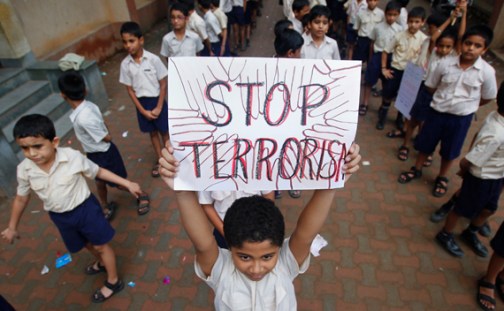
A student lifts a placard as he and others line up to take part in a march for peace in Mumbai

Very strategic point in counterterrorism in Pakistan to understand is the fact that many anti-social, anti-Pakistan and criminal elements have joined together to advance their own agenda by creating anarchy through terrorism. Among them, drug traffickers, smugglers, enemy country agents, underworld mafias, land grabbers, exporters, and weapon dealers are in the forefront as the weak state authority is always ideal for them to operate with impunity. As a result, they have started investing in terrorism. They can offer cash, vehicles, weapons, suicide bombers, and protection to the terrorists.

Most importantly such elements easily enlist public support where the legitimacy of the government is controversial and where government hardly has any legal or moral stance or roles to play, such as in FATA and GB. Such ungoverned areas should be brought under the umbrella of the constitution without any further delay and the local people of those areas must be taken on board while taking economic and political decisions affecting their lives.

Therefore, in this whole game of terrorism and counterterrorism, this essay argues, the winner will be the one who will have on his/her side what we can summarise as “Public Support”. If people of the country are on the side of the terrorists, they will win; if people side with the government, the terrorists will lose. So let us defeat terrorism with democratic counterterrorism by exploring and exploiting its potentials in Pakistan.


The Writer is a Novelist and a Law Enforcement Educator…References

References

[1] Leonard Weinberg, “Democracy and Terrorism: Friend or Foe”, (2013) Routledge, Taylor and Francis Group, London & New York.

[2] BHUTTO, BENAZIR. 2008, Reconciliation Islam, Democracy & The West, London, Simon & Schuster


Crime and Punishment

J. J. Baloch

195cardinalreads

Though the origins of crime and punishment are linked with the origins of the statehood yet the punishment for wrongdoing is tied with human origin on earth. The evolutionary phases of what is wrong and what is right for humans as thinking social animals described by culture, religion and state. From deviance down to sin and crime, wrongdoings have been punished with different sanctions. However, the system of formalised punishment has been birthed by the state.

In primitive societies where the existence of religion as a fear factor behind expected behaviours had been obscure the human common sense and rational thinking can be credited as the sole force behind declaring certain acts as wrong invoking certain punishments. The anthropologists and sociologists are not sure as to when exactly this started at a certain point of time yet they maintain that the human society has never been without fundamental concepts of expected behaviours.

good-evil

The state of nature as described by Hobbes, Locke, and Roseau as a pre-social and pre-political condition of human civilisation is said to have followed certain unwritten rules called customs and norms. The customs and norms have always regulated human behaviour and have greatly influenced human thinking on human living. It is interesting to note that some unwritten customs have been more effective than modern legal codes on both the adoption as well as the implementation by their respective communities.

The unwritten codes have been effective because of many reasons. The first and the foremost force behind acceptance of such unwritten rules have been the strong sense of ownership of concerned communities who evolved and adopted those unwritten rules. Secondly, ownership of such customs by the communities was based on the basic premise that such rules were made by those communities adopting and implementing them. Thirdly, the unwritten customs had behind the driver of cultural moralism which was the way of life of the people in the state of nature as discussed in the political theory of social contract.

MV5BMjI0NjMyODk2N15BMl5BanBnXkFtZTgwMDA1ODY1MjE@._V1_UY268_CR14,0,182,268_AL_

It was perhaps the reason why the French Enlightenment philosopher JJ Roseau always idealised the natural societies by painting the state of nature or pre-state societies as ideal conditions of human civilisations. Unlike Hobbes who believed that the human life in the state of nature was miserable and anarchic, a condition which underlined the need of formalised social institution of the state, JJ Roseau maintained that early societies relied on unwritten customs that often were more rigid than the written rules and were followed voluntarily rather than they were enforced by legal sanctions but the state was created for developing a system of progress, development, and advancement in an organised and systematic way.

The unwritten rules are more rigid and uncompromising and people in many cultures voluntarily and willingly follow them as a part and parcel of their very identity, name, fame, survival and success. In some cultures, public behaviour is very determined and disciplined so much so that that strictly follow when to stand, sit, eat, sleep etc. “There is little argument that the earliest laws were derived from folk customs, evolving from loose but unquestionable rule to fixed but more specific practices. Until relatively recently, many anthropologists scoffed at the notion of legal life in primitive cultures but instead saw ‘custom as the king’.” Law has always existed in one form or another. Without rules to maintain order and to make progress, anarchy threatens the very existence of a community.

Therefore, “one of the most intriguing questions facing anthropologists, criminologists, sociologists, and other scholars of governance and justice systems as to how the earliest pre-literate societies managed to not only survive but also maintain peace and order without written law codes.”( Michel P. Roth-2010)

In addition to human culture, the ideas of Godhood as supernatural powers in the forms of different religions have played a leading role in the development of what we understand criminal justice system in modern terminology. The punishment has been the main instrument for religions to inspire fear in people. However, greed for rewards such as paradise has also tempted many for following the line of religious doctrines. Wrongful acts are declared sins which are the individual acts for which the doer is personally responsible to God.

“When the members of a society believe that consequences of a sinful act will spread to the entire group, rather than affecting just the sinner, sins become crimes.” Any breach of custom or injunction would invoke the wrath of their gods against the breaching individual his community. The responsibility and punishment were collective in nature. The highly punishable acts have been profanity, blasphemy, and sacrileges while the punishments of dunking, stoning, and whipping were used to humiliate the sinners. Therefore, it goes without saying that the religious injunctions have been a very impactful influence in controlling human behaviour and disciplining them.

The birth of state paved the way for the dawn of the written laws. The state was believed to be the divine institution -the idea of statehood which was challenged by many Greek philosophers like Plato and Aristotle but was dumped by Machiavelli, an Italian philosopher who maintained that state was human, not a divine institution. Further JJ Roseau challenged the all kinds of rulerships by advocating for popular sovereignty in his concept of ‘General Will’ which maintained that right to rule rests with the people and social contract between the state and communities was not absolute but rather conditional. People agreed to obey laws and pay taxes in exchange for their protection of life, property, and civil liberties.

The theory of General Will sparked revolutions for civil liberties. The most important following the theory was French Revolution and American war of independence during the second half of the 18th century. The evolution of the state came with the concept of citizenship. In addition, the concept of individual property rights made individuals the distinct social entities with economic powers. Before this, all property in the empire belonged to kings who had sole wish to allow to any subject who had no rights but slaves.

Here laws were made to clear the rights and duties of all the signatories of the social contract including the state and its citizenry. From here was born the concept of constitutions and the modern criminal justice system comprising police, court and prisons came into shape during the revolutionary times of the last quarter of the 18th century.

The Bill of Rights, the American Constitution and many other constitutional documents came into existence describing the nature and functions of the state underlying the rights and duties of the citizenry. However, E. Adamson Hoebel in his study of primitive law maintains that the code of Hammurabi is a well-preserved Babylonian code of ancient Mesopotamia and oldest deciphered written document with significant length in the world dating back to 1754 BC.

The writing and codification of law especially constitutional, penal, and criminal defined certain acts as crimes punishable under the penal codes. In Eighteenth-century England the most serious secular crime was treason and the most serious religious offence was sacrilege. But today human rights violations are considered as the serious crimes against the laws and values of postmodern culture is based on civil liberties. In primitive times humans saw threats to their communities more seriously than the threats to the states which came to limelight during the middle ages and which still continues to struggle against the modern human rights discourse of the world without borders.

State functions through its laws and the source of ancient laws were the kings and of modern law the people: for the people, of the people, and by the people. Crime is what the law says it is, to put it very simply. not every violation of the law is the crime nor yet it is a sin or deviance. However, crime is classified in six major categories i.e. violent crime, property crime, public order crime, white collar crime, organised crime and cybercrime. Punishment for these types of crimes varies from restitution, fines, probation, imprisonment, and death sentence.

Therefore, the criminal justice system has existed in human society in one or another form and has undergone different phases of evolution. Criminal justice is the system of practices and institutions of governments directed at upholding social control, deterring and mitigating crime, or sanctioning those who violate laws with criminal penalties and rehabilitation efforts.

Today Pakistan stands with criminal justice troika -three parallel justice systems: Jirga -a culture model, Shariah – religious model, and criminal justice -rule of law model. Ultimately, it makes us believe that we are witnessing anarchy and violence in our society because we are left with neither of these three systems intact but function in stark conflict.

We need to transform our conflict model into a consensus model where we should not have any difference on core values of crime and punishment.

The Writer is Policing Educator and Practitioner …


Whiter Than White by J.J. Baloch: Ratings, Reviews, Publicity and availability

Whiter than White by J. J. Baloch is now available in every corner of the world. The author is receiving requests for its translations in different global languages.

  1. Russia

https://www.bookvoed.ru/book?id=7333781

  1. Netherland

https://www.bol.com/nl/p/whiter-than-white/9200000070795910/?bltg=itm_event%3Dclick%26mmt_id%3D2a54fe0034a4d099%26pg_nm%3Dpdp%26slt_id%3Dprd_reco%26slt_nm%3Dproduct_recommendations%26slt_pos%3DC1%26slt_owner%3Dccs%26itm_type%3Dproduct%26itm_lp%3D5%26itm_id%3D9200000070795910%26itm_role%3Din

  1. United States of America

https://www.easons.com/whiter-than-white-j-j-baloch-9781788036641

http://www.kmart.com/troubador-publishing-whiter-than-white-author-j/p-SPM14588707415

https://www.scribd.com/book/341068954/Whiter-Than-White-The-daughter-of-the-Land-of-Pure

  1. United Kingdom

ebay wordery

https://www.ebay.ie/itm/Whiter-Than-White-The-Daughter-of-the-Land-of-Pure-by-Troubador-Publishing-/302269742231?hash=item4660ae3c97

http://www.troubador.co.uk/book_info.asp?bookid=4310

https://picclick.co.uk/Whiter-Than-White-by-J-J-BAloch-New-192310965620.html

https://www.thebookpeople.co.uk/webapp/wcs/stores/servlet/qs_searchResult_tbp?searchTerm=whiter+than+white+by+JJ+baloch&catalogId=10051&langId=100&storeId=10001

  1. Canada –

Indigo/ Rakuten Kobo

https://www.chapters.indigo.ca/en-ca/books/whiter-than-white/9781788036641-item.html

https://www.kobo.com/ww/en/ebook/whiter-than-white-2

  1. Belgium and Luxemburg

http://www.standaardboekhandel.be/seo/nl/boeken/literaire-fictie/9781788036641/j-j-baloch/whiter-than-white

  1. Germany

https://www.zvab.com/products/isbn/9781788036641/22351646593

https://www.jpc.de/jpcng/books/detail/-/art/j-j-baloch-whiter-than-white/hnum/6604749

https://www.buecher.de/shop/belletristik/whiter-than-white-ebook-epub/baloch-j-j-/products_products/detail/prod_id/47906101/

https://shop.autorenwelt.de/products/whiter-than-white-von-j-j-baloch

http://de.zogshop.com/product/YW16X0IwNlhHMkYyUDM/catalog/whiter-than-white-the-daughter-of-the-land-of-pure-english-edition?f=33F52711-9092-3187-6D57-A3C21B3DE135

  1. Spain

https://www.iberlibro.com/servlet/BookDetailsPL?bi=22312753097&searchurl=sortby%3D17%26an%3Dbaloch&cm_sp=snippet-_-srp1-_-title3

  1. Denmark

https://boekentips.com/boek/9200000070795910/whiter-than-white

  1. Sweden

https://www.akademibokhandeln.se/bok/whiter-than-white-the-daughter-of-the-land-of-pure/9781788036641/

  1. Norway

https://www.adlibris.com/fi/kirja/whiter-than-white-9781788036641

  1. Estonia

https://www.rahvaraamat.ee/p/whiter-than-white/853914/en?isbn=9781788036641

  1. Italy

http://www.abebooks.it/servlet/BookDetailsPL?bi=22312753097&searchurl=sortby%3D17%26an%3Dbaloch&cm_sp=snippet-_-srp1-_-title3

  1. New Zealand

https://www.fishpond.co.nz/Books/Whiter-Than-White-J-J-Baloch/9781788036641

  1. Australia

at wounded women book and booktopia.au

https://www.fishpond.com.au/c/Books/q/The+Wounded+Woman+Books+whiter+than+white+by+J.J+Baloch?rid=1443094903

https://www.dymocks.com.au/book/whiter-than-white-by-baloch-j-j-9781788032377/#.WjAhdlWnHIU

https://www.booktopia.com.au/whiter-than-white-j-j-baloch/prod9781788036641.html

  1. Pakistan

Paramount Books

http://paramountbooks.com.pk/loginindex.asp?title=WHITER-THAN-WHITE%3A-THE-DAUGHTER-OF-THE-LAND-OF-PURE-%28pb%29-2017&isbn=9789697634026&opt=3&SubCat=05&Cat=05009

Reviews

http://blogs.trendolizer.com/2017/11/whiter-than-white-a-book-review.html

http://thatsbooks.blogspot.com/search?q=JJ+Baloch


Towards the Telemetric Policing


J. J. Baloch

Related image

Use of telemetry in policing is not commonplace in Pakistan. The telemetric Policing refers to ‘distant surveillance of crime, disorder, offending, traffic violations, policing and other similar situations/activities by the police of both the public as well as the police, employing electronic apparatuses which include: CCTV, Safety Cameras, point-to-point cameras, red-light cameras, speed cameras, drone cameras, bar code readers, magnetic stripes, Radio frequency identification devices, Radars, and other similar instruments which enable police make the most of the technology in cutting crime.

Thus, Telemetric is a practical digital policing application, like biometric and forensic methods, to gather data but unlike biometrics and forensics which require physical contact for their applications, the telemetric model operates from remote digital sources. The process of measuring data at the source and transmitting it automatically is called telemetry. The word is derived from Greek roots: tele = remote, and metron = measure.”

Policing worldwide is witnessing drastic changes in the wake of emerging digitalism in almost all spheres of life,  including law enforcement too. In last fifteen years, this trend is speeding and expanding beyond imagination due to the development of technologies of social media as well as telemetric surveillance. The introduction and advancement  in the areas of ‘simulated justice, forensic investigations, biometric data, automated intervention in vehicle control, facial recognition software, also minor public order infractions’ and many other algorithmic monitoring appliances have added much to the meteoric rise in telemetric policing model in many advanced and high-tech countries like USA, UK, Canada, Australia, Japan and many others. However, police telemetry is yet to receive any political attention in Pakistan.

Pakistan has also begun to think but not yet in a true techno sense but only some cops are captivated by this idea and try professionally on individual levels to implement technologies such as the one in point. Islamabad, KPK, NHMP and FIA are worth a few police departments who are trying to rise equal to the challenge and who badly needs some financial support on the part of the government to meet the expenses of new technology.

Karachi and Lahore police departments have also begun some of the telemetric policing functions but in piecemeal, not in Toto and not in all spheres. Basically Telemetric methodologies involve distant control mechanisms such as CCTV and other cameras use excessively as is the case in London and other cities where every activity is monitored silently and minutely without showing too much police on the roads and streets and where every police vehicle is digitally monitored as to what the on-duty cops are doing and where are they right at the moment of checking in real time. This enables control to respond to any emergency very well in time and effectively. Lahore police have gone for integrated command and control centers called IC3 which also perform same functions of surveillance. In police, we always need to monitor first our police and then public and their criminal activity. Similarly, safe city project of Islamabad police also involves similar telemetric surveillance systems of command and control using cameras.

In telemetric policing we monitor police through tracker chips in their vehicles, safety cameras in their vehicles and their cell phones; while to the public through CCTV and Cyber detection instruments used to monitor social media content, for example, hate material. Lahore police are good with adopting police force surveillance command and control but not public and their activities to the required extent. While on the contrary, Karachi police are good at monitoring public but poor and no system of digital monitoring of police officials on duty. Video Conference system was introduced in Sindh police by worthy IGP Mr. Iqbal Mehmood in 2014 when he was IGP Sindh. He used to talk to DPOs and DIGs of distant places daily in terms of news about crime and any disorderly or untoward situation. This was very effective as well as cost-effective. This was also time and resource saver as nobody holding important public positions was to leave for two to three days and travel four to eight hours one side of his or her journey to attend IGP meetings.

Many digital policing experts believe that the new telemetric policing technologies are perfect, accurate, tireless, reliable, cost-effective, and productive. Once installed such technologies require no much expenses for maintenance or wear and tear as do others things likes horses, dogs, and other animals or human spies require. When violations or offenses are identified through telemetric processes, a lot of revenue is generated in the shape of fines. Thus, it goes without saying that the telemetric policing methods go a long way in performing policing functions by registering offenses and infractions directly and more efficiently.

In the wake of challenges we face today in Pakistan, adoption of telemetric policing is as important as biometric, forensic, cyber and any other digital or scientific model. The information revolution has enhanced beyond measure the impact of this embedding telemetric policing into a fully digitalized criminal justice procedures and sanctions which are performed ‘online’.

If we look at very recent CCTV footages of the kidnapping incident of Barrister Syed Owais Ali Shah we will find that how important they are, though due to faulty cameras with low pixels capacity installed by government contractors in Karachi yet these footages helped police to make some sense of how everything was executed and which vehicle was used. Something is better than nothing; but had we been able to have better cameras strategically placed, we would have been able to locate the kidnappee until now. This is how corruption and hence inefficient policing methodologies are eating into the vitals of public peace.

Here are some suggestions in respect of going telemetric in policing here in our part of the world. First, for the adoption of telemetry in policing on a uniform basis by all police departments countrywide, The National Police Bureau must issue guidelines regarding calling details on budgetary requirements through SNEs analysis and their present use of telemetric technology assessing each department’s present capacity so that its further additions could be identified. Secondly, All eight or ten police departments in Pakistan must do three things: (a), appoint a focal person who must not necessarily be a police officer but digital expert. who may be hired or his/her post be created like forensic experts for permanent appointment as a separate cadre; (b) All police department should Submit detailed reports of their present capacity or the technology application level (c) Budgetary capacity and requirements for further adoption of telemetric technology by all police departments. Thirdly, NPB may be tasked to shortlist the apparatus and appliances to be purchased, how and from where. Fourthly,  National Highways and Motorways Police (NHMP), Islamabad Police, Lahore Police, Karachi police, KPK police and other police departments who are bit advanced must share their experiences of telemetric policing methodologies.

last but not the least, telemetric policing is not all policing but part of it and its adoption means the addition to what we are doing. It never calls for relinquishing the older methods. It is a way of improving the areas of policing that do not fall under telemetric methodologies may better be explored separately as for example forensic methods which are vital for investigations.

In the wake of above compelling reasons to improve efficiency, going telemetric has become the call of the day for police departments in Pakistan on an urgent footing.  Especially in their major cities, this appears to have become inevitable now. Any delay or dithering will cost us an irreparable damage.

WRITER is a senior police officer at police service of Pakistan.

The Lone Wolf Terrorism

J. J. Baloch

Image result for lone wolf terrorist

A lone-wolf terrorist is one who commits violent acts in support of a group, a movement, or an ideology, but who does so alone, outside of any command structure and without material assistance from any group. The hearts of experts of counter-terrorism miss a beat as what to do with lone wolfs.

Many studies surrounding the reasons behind the concept unveil that too many checks, evenings of state-sponsored terrorism, strict policies of immigration, unavailability of any local command structure due to pro-active policing in western world and abroad have given birth to the emergence of internet based groups who were living in geographically isolated and far away regions but using cyber connectivity, which in its initial years was out of the monitoring of law enforcement agencies due to strict privacy policies, the extremist ideologues created their cyber clientele to preach their grievances, giving birth to a mega cause to pursue.

Things got much clearer and much dangerous after the emergence of social media sites such as Google, Facebook, Twitter, YouTube and many other sites __leading to the age of explosive content which we are living now.

We found cases like the Boston Marathon Bombing, the Oklahoma City Bombing, or even 9/11 attacks carried out by “lone wolves.” We found that in 24 cases between 2013 and 2015, 22 were labelled “lone wolves” even though only a third actually involved a solitary attacker. This research coincides with evidence found from pre-2013 studies.”
In order to keep police away from the command structure or being able to disclose the network, ISIS and Da’aish promote the lone wolf terrorism by design so that in case one is arrested then he or she may not know anything more than himself or herself with the intention to pre-empt the arrest of the rest of group.

Why terrorists adopt lone wolf policy? To quote Tures who argues: “In order to carry out their asymmetric warfare, terrorist organisations would need attackers beyond the normal network. Terrorists would seek to recruit such disgruntled individuals to the cause, and let them figure out how an attack could be carried out on their own. These terror groups sacrificed command and control power over these new followers. But, in theory, such new recruits could be harder to track, and stop.”

One of the many leading trademarks of the lone-wolf terrorists is revealing their plans long before committing an act of violence. Researchers unwrap that lone wolfs seek public attention and recognition for their cause in so doing. Another landmark lone wolfs, according to researchers, is targeting of uniformed police and military personnel primarily. In such attacks, high-velocity firearms are now the weapons of choice. Prior to 9/11, lone-wolf terrorists didn’t attack a single member of the US or even Pakistan military by design, let alone by default incidents.

According to researchers at different international forums, more than 80% of lone wolf terrorists disclose publically in advance their plans to commit terrorism. Researchers Mark Hamm and Ramon Spaaj in a report, which analysed 98 cases of lone-wolf terrorism in America between 1940 and 2013 have identified a large number of signatures.
Such examples of lone-wolf terrorists abound: Nidal Hasan killed 13 people and injured many more in 2009 Fort Hood Shooting, Paul Ciancia killed one TSA officer in 2013, and in similar vein, the marathon bombings in Boston, Paris attack in 2015, Brussels attacks in 2016 and also failed French train attack and many more to refer. Besides this, in 2014 Canada witnessed a series of lone-wolf attacks inspired by radicalism.

Time Magazine October 23, 2014, Naina Bajekal mentions that Zehaf-Bibeau killed a Canadian soldier outside parliament in Ottawa and “Martin Rouleau-Couture drove his car into two military members, killing one before he was fatally shot by police, and a month after Alton Nolen beheaded a co-worker in Nebraska. All three appeared to be recent converts to Islam.”These all lone wolfs publically shared their designs through email, text messages, Twitter, Facebook, YouTube, Post casts and other social media ways.

Elaborating its complexities, Victoria Bekiempis quotes Barton’s briefing in Newsweek dated 13th September 2015 in these words: “ISIS has embraced a diffuse, ‘lone wolf’ model, which encourages unaffiliated independent operators to do whatever damage they can with whatever is at hand…This threat is decentralised and much harder to detect than threats orchestrated by Al-Qaeda. ISIL’s alarmingly effective messaging—as refined as anything found on Madison Avenue or in Hollywood—reaches marginalised, solitary actors. These are terrorists who largely operate outside the kind of command-and-control systems, or cells, that we have learned to penetrate and dismantle.”

She further adds: “Bratton and the NYPD’s deputy commissioner of intelligence and counterterrorism, John Miller, “have said many times that the ‘lone wolf’ type of potential attack seems to be a more likely scenario” than the large-scale attacks typically organized by Al-Qaeda, Stephen P. Davis, the NYPD’s deputy commissioner of public information, tells Newsweek in an e-mail. This would include lone wolves inspired by the terrorist group Islamic State (also known as ISIS, or ISIL).”

Professor of Political science, LaGrange College in Georgia, John A. Tures is of the view that the lone wolf terrorism is a myth and a false flag terrorism; They maintain: “The myth of lone wolf terrorist is one that assumes terrorists are born that way. They are lifelong solitary individuals, akin to the Unabomber, striking at a completely random target, only to disappear into the shadows, without a hint to law enforcement. But that’s not always the case…Terrorists are actually more likely to be made, not born. We found that such lone attackers tend to be male, a little more likely to have more than a high school education, and have experienced a recent change, like a lost job, a broken relationship, a move to a new area, or something that altered one’s traditional life.”

Respecting the findings of the critic lone wolfs, I am of the view that lone wolfs are the reality not because who makes them or how are they born or not but because it is part of their strategy to keep terrorist activity preparations secret unless it matures into a violent act with a design to skip police preemption.

The more lonely one feels or become, it is more likely for him or her to resort to social media outlet for his or her emotional and intellectual outbursts. So there is a greater likelihood of future attacks in Pakistan so we must ensure strict social media surveillance through appropriate digital intelligence.

Writer is senior police officer from police service of Pakistan

Moral Policing is a Crime

J. J. Baloch

moralpolicing1

There is growing consensus among the scholars and activists of modern policing that ‘moral policing is a crime’. Hardly anyone related to the profession or apart can disagree this. In its deeper and literal sense, a police officer is expected to discharge his duties that the law, not morality, expects and mandates him or her under the oath to perform. 

Behind any law stands the state which owns it and constructs sanctions behind the law by making it clear to its citizenry that any violation of law has its consequences for the violators. Enforcing morality is not mandatory for any police organisation, though sometimes facilitating it brings good name to police but only in some parts of the world, so it cannot be said to be universally true.

The law is a citizen-state affair, while morality is individual’s personal matter partially with society and culture and primarily between God and humans. The state is not a divine institution; it is a man-made phenomenon developed by humans for peace and progress while living in a society. However, things divine do have their consequences for the life after death. The major sources of the morality are divinity and revelations. Here comes the role of religion in human life. There are many religions which mankind practice with one central commonality and that is the concept of Godhead and life after death.

Religion defines the human relation with God. Its teachings make its adherents aware of the consequences of not abiding by the commandments of God. This does have technical and corresponding impacts on how humans build their concepts and sketch the images of the state and its inherent sovereign power. According to some religions including Islam, the sovereignty belongs to God. God gives sovereignty to the state for the running of the worldly affairs. There are others who contradict this point of view of state sovereignty. According to them, sovereignty belongs to the people who entrust it to the state through their elected governments who make laws, not code morals, for the well-being of the society. Morality becomes less relevant to law and politics in modern-day contexts.

However, Policing is a pure part of law and politics. Policing is a worldly activity which cannot claim any otherworldly responsibilities or consequences except the individual faith of a police officer for having consequences for him or her of the acts he or she performs in the capacity of being a police officer. This is optional and varies from one person to the other even if they belong to the same religion.

Law of the state mothers the police. The origins of police lie entangled in the wish of the rulers to control their populations who they feel could deprive them of their right to rule the people without any question raised or any finger pointed against them or against their rule. As a result of the police invention for controlling the socially uncontrolled and politically disobedient people, the police emerged as a force model with the notoriety of coercion, highhandedness, torture, and inhuman behaviour.

This aspect of the origin and standing of police as law enforcing agency bring home the fact that the police are for the rule of law. It matters least what is the source of law, either the words of the king or a piece of legislation by the publically elected legislature. State pay police for being loyal and sincere to the integrity of the state and security of its order.

However, the changes in the state citizenry relationships in the aftermath of the French revolution and American war of independence during the second half of the 18th century have redefined the way police is supposed to be the blind follower of state maximums. Now the democratic world has offered police a golden opportunity to define their role and mandate as the unbiased and impartial protectors of public rights, liberties, properties and life.

During the times we are living, the police claim to be a public service with the clear mandate to uphold the rule of law according to which the remedies against the violations of fundamental rights of the people are constitutionally available even against the state. The Democratic order claims to have stricken a beautiful balance between the individual liberty and the state authority, minimising anarchy as well as tyranny.

Policing democracies is bit different and difficult in comparison to policing tyrannies in authoritarian societies. Policing a society where public know the value of their single vote which really matters a lot beyond any shadow of doubt call for excellence in police professionalism and practical work. In such environs cops working according to their emotional undertones are bound to surface as biased in terms of gender, ethnicity, race, religion, region, ideology, colour, language, culture and so on; his or her prejudices predominate his professional work and burn his or her potentials for building peace in the society.

The police officer is a law officer, therefore. He should stay away from being an emotionally charged entity which brings nothing but disaster to all. In this age of information anarchy, nothing is hidden from the eye of media and people are well aware of their rights of privacy and freedoms. Making searches of who is dating with whom and who is in love relations with whom or who is earning how much and why or who drinks and who does not are something that divert police focus on order, security, safety, and other law enforcement duties, waste the precious time of officers, get officer into unnecessary arguments, and also tarnish the image of police as helpers and protectors.

There is no harm if police officer stops drunk drivers for his or her own benefit and safety. It becomes a legal action, not because of driver drinks but because he drives drunk. Therefore, if he or she drinks it is a moral domain which converts into the legal arena when a drunk person drives because the law does not allow him or her to drives in such a condition due to safety rules and hence try to protect drunk driver to fall.

In the light of above analysis, moral policing is, indeed, a marked departure from primary professional duties of law enforcement and tend to create more problems for the police officer on duty as well as for the public persons who he or she deals with. Therefore, moral policing is a deviance which in many cases qualifies to be a crime but may or may not be a sin! However, the police officer must choose what our law of the land expect us to do in the capacity of being the law enforcers in the best interest of the public.

Cyber Terrorism

J. J. Baloch

b239628b8738a8879e730e1cb3ae12ec

It was 1996, a computer hacker allegedly associated with the White Supremacist movement temporarily disabled a Massachusetts Internet service provider and damaged part of the ISP’s record keeping system. The concerned service provider tried to stop the hacker from sending out worldwide racist messages under the ISP’s name. The hacker signed off with the threat, “you have yet to see true electronic terrorism. This is a promise.“ Since then the cyber terror attacks know no stopping with every new attack with increased severity.

The ever expanding internet of things has transformed the world to unimaginable levels. From economy to politics, the new culture of human connectivity in real time keeps on innovating new ideas for a new and a parallel human society based on new interactive models wherein the ideas of national security, public safety, national identity, governmental controls and the geographical borders are withering away and losing grounds. It is a phenomenon where “the loudest and the most opinionated” making their marks on public minds. Terrorists have found cyberspace as a new hideout, using anonymity to carry out their distant missions.

Problems-with-Cyber-terrorism-Classifications

Cyber terrorism, like conventional terrorism, is difficult to define. However, simply putting it is a form of terrorism which is carried out using the mechanism of the internet and social websites for communications and audience outreach. For this end in view, the experts have defined cyber terrorism as: ” the intimidation of civilian enterprise through the use of high technology to bring about political, religious, or ideological aims, actions that result in disabling or deleting critical infrastructure data or information” (William Tafoya, Professor of Criminal Justice at the Henry C. Lee College of Criminal Justice and  Forensic Science at the University of New Haven, USA).

While Center for Strategic and International Studies (CSIS), An American Think Tank group at George Washington University, Washington, USA, refer to cyber terrorism as “the use of computer network tools to shut down critical national infrastructures (e.g., energy, transportation, government operations) or to coerce or intimidate a government or civilian population.” Cyber terrorism is said to be the element of information warfare but on the contrary information warfare is not cyber terrorism. This is quite clear as to what is cyber terrorism.

The latest research at Harvard Kennedy School has found that there are more than forty designated cyber terrorist organisations that maintain their own websites, mostly with anonymous names and use different languages and scripts. Some very infamous organisations using cyberspace include The Unix security Guards, The popular Front for Liberation of Palestine, Irish Republican army, Al-Qaida, ISIS, The Basque ETA Movement and much more based in India and Israel. Some of their purposes are to change public opinion, weaken public support for a governing regime, and even take them down.

hacking_wordcloud

Now it is important to understand as to when cyber terrorism did begin and who did start it. The term was coined in the 1980s by Barry Collin, a senior research fellow at the Institute for Security and Intelligence in California. In 1997 Barry Collin was attributed for the creation of the term “Cyber-terrorism”. He defined cyber-terrorism as the convergence of cybernetics and terrorism making what is called cyber-terrorism.

Also the Amendments under the American Information Technology Act, 2000 have defined the term “Cyber-terrorism” under Section 66F. This is the first ever attempt to define the term. According to the insertions, “It includes threatening the unity, integrity, security or sovereignty and denying access to authorised person to access a computer resource.” However, Section 55 of International Penal Code (IPC) fix the punishment of life imprisonment or not less than fourteen years while in many countries the crime of cyber terrorism invokes the death penalty. Pakistan’s Electronic Crime Act, 2016 is little soft on cyber crimes.

In the early 1970s, the U.S. Department of Defense wanted to reduce the exposure of its communication networks to nuclear attack during the days of the Cold War. However, these security controls got weaker in the 1980s when internet opened up for commercial purposes and many brands began to use it not only for their fast communications but also for advertisement and publicity mid-1990s-1990s the Internet-connected more than 18,000 private, public, and national networks, with increasing numbers along with 3.2 million host computers and as many as 60 million users spread across the globe. Now in 2017 the number internet users, spreading to all age groups, has expanded to more than 4 billion worldwide. Smartphones have added fuel to fire.

The terrorist organisation which for the first time began to float their video and audio messages on social websites when they were denied access to traditional media due to regulatory laws was Al-Qaida of Osama bin Laden. But recently, the Islamic state of Abu Baker al-Baghdadi has been using social websites and cyberspace to cultivate their sources of terror worldwide as their personnel are very expert masters in the said job of reaching to the happiest teen victims to attract them towards their cause without much effort.

The Islamic state is seriously working on what the western digital experts are describing as the cyber caliphate. By this idea, these experts refer to the scenario where the Islamic state could grow itself into a cyber state in which its citizenry would include all converts on oath who could be carrying out their dictates in different parts of the world wherever they are locals citizens. The cyber caliphate charge no tax, restrict no freedom, prepare soldiers and many cases rather pay them to stay local to their cause with eternal promise to have a ticket to paradise. Many, mostly those who are fed up with their governments and their discriminatory policies, fall happiest victims to terrorist calls which pitch poor teens against their own societies to intimidate and kill their own people for hollow and distant hope of getting rewards.

The cyber terrorists may use the tools of cryptography, radar jamming, high-altitude aerial reconnaissance, electronic surveillance, electronically acquired intelligence, and steganography for their terror business. The distinction, however, is not the technological tools employed but the context and target, so evaluate the experts. They further maintain that the countries which have mostly been the target of cyber terrorism include United States, Korea, China, Germany, and France.

cyber-terrorism-hacker

Many scholars of internet culture and social media are struggling to know as to why the tendency of cyber terrorism is being increased without stopping despite the fact that the governmental regulatory and law enforcement agencies are making their all-out efforts to prevent such terrorism. Some scholarships find that cyber terrorism is preferred because it is very cheaper, easier and less risky. Secondly, the element of anonymity enables cyber terrorists to escape the identification, arrest or any other likely military or law enforcement action. Thirdly, it is also maintained by the research that the borders, distances and other barriers do not matter in it and anything can be done from anywhere. Lastly, the internet offers access to large populations and audiences.

Therefore, the cyber safety is going to be the biggest and the most daunting challenge facing security and law enforcement agencies in near future; it will be too important field to be left to the law enforcement only but communities, businesses, media and academia will have to play their due role for the peaceful tomorrow for our off-springs.

THE WRITER IS A POLICING EDUCATOR & PRACTITIONER…

The Cyber Sovereignty Challenges

J. J. Baloch

top02-032017

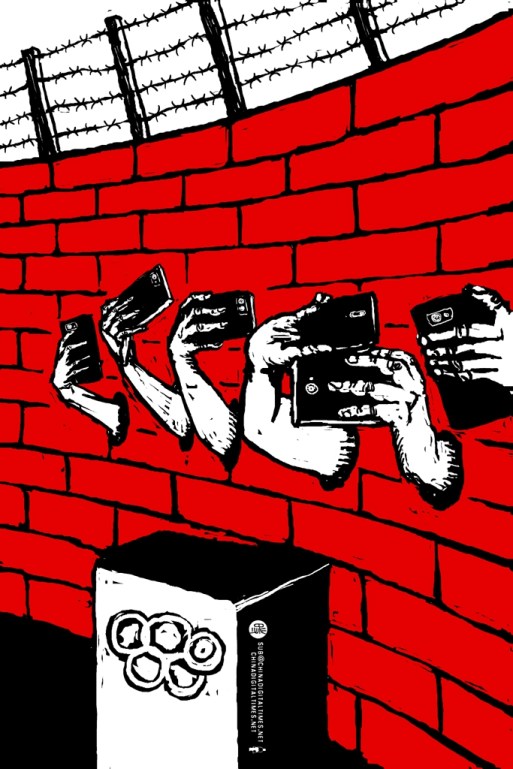
“Strike hard against online rumours, harmful information, fake news, news extortion, fake media and fake reporters, media must follow the party line, uphold the correct guidance on public opinion and promote ‘positive propaganda’, so states the President of China Xi Jinping a few days back. The statement has created worldwide media ripples that China is going to block popular foreign social websites such as Google and Facebook very soon.

The world goes borderless in a post-internet era where political governments having jurisdiction over their territorial domains find it quite difficult to ensure their controls in cyberspace. Easy access in real time exposes youth to the content which could be explosive but inevitable too. The different rounds of talks and understandings between US and China on the issues of their controls on virtual world revealed many basic principles to ensure the sovereignty in global cyberspace.

Cyber sovereignty refers to internet governance. By internet governance, we mean ‘desire of the political governments to exercise political, economic. technological and cultural control over the internet within their borders. Many security experts, including Bruce Schneider, are of the view that cyber sovereignty movement is active in many countries including Russia, China, France, India, Turkey, Saudi Arabia and other middle eastern as well as East Asian states. This movement received a remarkable boost in 2013 revelations of widespread international NSA surveillance. However, many blame USA for hypocrisy on internet freedom issue.

The Tallinn Manual as developed by American and European Experts offers these words to shed light on the sovereignty, “the principle of sovereignty, in cyberspace, applies to network space, the claim expressed as a state within its sovereign territory can implement control on the information infrastructures and activities,” where the definition of sovereignty, based on 1928 Island of Palmas international law ruling, stressed that a country’s internal affairs are independent without interference from other countries; and on this basis, the sovereignty-related with cyberspace is expressed as referent with the information infrastructures in a state’s territory, airspace, territorial waters and territorial sea (including the seabed and subsoil); the direct consequence is those information infrastructures, regardless of their specific owners or users, are under the sovereignty of a country’s judicial and administrative jurisdiction, which is protected by sovereignty (Schmitt 2013).”

One of the political studies carried out by Chinese experts on cyber sovereignty reads: ” though China and US may have different narratives of how to apply cyber sovereignty principle to guide the governance of global cyberspace, both two countries pay special attention to how to ensure the cyber sovereignty in different ways. The US prefer to expand its cyber sovereignty, while China prefers to launch the cyber sovereignty defensively”.

Great Firewall Selfie August 墙中自拍 cdt

The issues of cyber governance, knocking at the doors of public policy, is a phenomenon which has come to limelight since 2010. It was exactly the year when wiki leakers disclosed secret cables and war files of the state and defence departments, so claims Kessler a cyber expert. The US introduced a new version of “cyberspace international Strategy” in which was clearly announced the intention of building a kind of hegemonic order in global cyberspace. From 2012 to 2013, there were a series of news stories about “Chinese cyber espionage attack” rendered as the new threat toward US national security.

However, there was insider disclosure of “PRISM Gate” by former CIA contractor Snowden in 2013. Very next year, the US Department of Commerce suddenly announced intent to “transition key Internet domain name functions. In August 2015, it announced the extension of the contract with ICANN for 1 year, directly making relations of cyberspace with different actors the focus of public attention”. Understanding this series of events is extremely important in the perspectives of international relations and newer colder war between China and united states.

The newer colder war is likely to influence the interstate relations and security narratives of the states involved in cyber power race. This cyber battleground is attracting not only state actors but also non-state actors too who wish to take over the domain exclusively for the outreach of their extremist narratives in every nook and corner of the world without any check and brake of the border, barbed wire, walk through gates, airport scanners, defence radars.

Experts of cyberspace give a very serious thought to this emerging scenario because they believe that this has greater “practical value and theoretical significance” in the strategic domain. In order to understand these new changes, the countries like Pakistan should begin to research and map the challenges arising from the issues of cyberspace to understand the cyber sovereignty challenges.

The first and foremost challenge in this area, according to cyber studies, is “the eroding of geographic borders of the states”. Secondly, understanding the role, function, strategic utility and the new characteristics of sovereignty is of vital importance to the geopolitical futurists. Thirdly, evolving the models to establish a cyber sovereignty for defending their cultural and ideological borders is one of the pestering problems facing the modern state. Fourthly, “although some scholars have pointed out, the real cyberspace is the logical space which is actually difficult to be accurately perceived and managed, cyberspace is unable to exist without supporting from the physical world”. Lastly, It is very difficult for cyber governance to ensure the presence of administrative authority in cyberspace.

Business concept enter China

Whether sovereignty can adapt to the challenges of cybersecurity is one of the key questions since 2009 and indeed one of the most difficult issues in dealing with cyber conflict. Perhaps, the main challenge in the area of cyber governance relates to the security that” rising of non-state actors produced tough conflict with the deploying of traditional international law based on the rule of sovereignty in these new areas”. In this regard, Herzog, a cyber security expert, maintains that “it is quite clear that the sovereignty must have a proper position in handling with cyber security issues when more and more multi-source attacks have appeared in cyberspace.” Another expert of cyber politics Drezner adds saying, “though at the very beginning the term governance referred to governing without the government, the government or the sovereignty state must be brought back in.”

Very recently China’s government has pledged to bolster their cyber sovereignty by ensuring stricter controls on the internet content. In this regard, President Xi Jinxing of China has directed his national cultural department to strengthen controls on search engines like Google and international news portals. The Chinese government is very much concerned about losing their communist ideological controls on their youth if they think they fail to prevent the easy and free flow of rumours and unverified content to penetrate their homes. As a result, they are going to adopt their five-year cultural plan and strategy to perfect their internet regulatory laws as they claim.

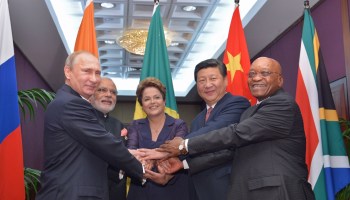
BRICS2

Keeping in view the worldwide trends and fears of likely cyber wars in future, Pakistan should invest into cyber defence and sovereignty because India being our competitor is on her way to doing something significant into it in the wake of China’s cyber offensive. We need to explore our room in cyberspace very diligently and timely before we lag far behind.

The Writer is a policing educator and a novelist…  


Terrorism: A Crime or a War


J. J. BALOCH

taxi

The modern discourse on national security finds it hard to reach some definite classification of terrorism as a law enforcement challenge. Whether terrorism falls within the crime frame or is a form of warfare poses a very genuine dilemma to scholars and practitioners as well.

From our National Action Plan, Zarb-e-Azab and now to Rad-al-Fasad Pakistan also struggles to fix its counterterrorism discourse and also to set its tone after placing terrorism in either of the two frameworks or to develop a well-crafted and articulately reasoned mix of the both.

However, with a variety of explanations, the world’s leading nations in counterterrorism such a USA, UK, Canada, and many other allied countries share many common values on counterterrorism, yet their definitions and legislative interpretations appear not in line with what they preach in media and on political forums.

This essay will attempt to scrutinise the content of counterterrorism laws as well as the media and political claims of the leadership of the states which have been actively involved in fighting terrorism. Legal contents of the Acts passed in different parts of the world including Pakistan, USA, UK, and Canada and in many other parts of the world describe terrorism ‘a form of organised crime’. While on the contrary, the media magnification of terrorist threat worldwide both by political leaders as well as the renowned journalists post this threat of terrorism as the “form of a modern warfare”.

war-is-terrorism

The detailed scrutiny of relevant laws of different countries reveals in very clear terms that “terrorism is a type of a crime”. For example, Canada’s Criminal Code on terrorism reads: “In whole or in part of a political, religious, or ideological purpose, objective, or cause with the intention of intimidating the public…with regard to its security…including economic security, or compelling a person, a government or a domestic or an international organisation to do or to refrain from doing any act.”

Similarly, Terrorism Act (2006) of United Kingdom defines terrorism as a form of crime in these words: “a threat or action designed to influence the government or to intimidate the public or a section of the public for advancing a political, religious or ideological cause” would constitute a criminal act. Moreover, violence against people, damage to property, endangerment of life, risks to the health and public safety are key criminal areas outlined by the UK Terrorism Act.

The Patriot Act (PA) in the United States defining terrorism as a criminal act reads: “Terrorism is a violent criminal act which is dangerous to human life…that is a violation of the criminal laws of a state or the United States.” Patriot Act further explains that if the act intends to: intimidate or coerce a civilian population; influence the policy of a government by intimidation or coercion; or, affect the conduct of a government by mass destruction, assassination or kidnapping” would fall into the category of terrorism.

Pakistan’s Anti-Terrorism Act 1997 refers terrorism as an “action” involving death, grievous violence, grievous body injury, grievous damage to property, threat to person’s life, kidnapping for ransom, hostage-taking, hijacking, hatred or violence on the basis of religion, sect, ethnicity, caste, race, colour, stoning, brick-batting or any other form of mischief to spread panic, attacking or firing on religious congregations, mosques, imambargahs, churches, temples and all other places of worship, or random firing to spread panic, any forcible takeover on mosques or other places of worship, a serious risk to public safety, any public disturbance in carrying out their lawful trade and daily business, and normal civil life,  the burning of vehicles or another serious form of arson, extortion of money, disruption in a communications system or public utility service, serious coercion or intimidation of a public servant in order to force him to discharge or to refrain from discharging his lawful duties, and a serious violence against a member of the police force, armed forces, civil armed forces, or a public servant. (Section 6, sub-section 2)

In order to try the criminal cases falling under these categories, special courts were established on district level in Pakistan but their dismal performance made governments realise the need of some ad hoc measures and hence military courts under NAP were established.

On the contrary, the review of media claims of political leaders brings out that” terrorism is a form of a war”. The political culture, media traditions and popular rhetoric make us believe that terrorism is something more than merely a criminal act. The scale and magnitude of terrorist attacks and the fear of the fear of terrorism invoke the ghost of war in general public. As a result, the players, as well as sellers of public sensitivities, consider war as an equivalent and appropriate response to terrorism. Many experts of terrorism believe that the phrase ‘act of war’ is a political phrase; it is not legal. “Historically, ‘act of war’ usually referenced the rationale for nations to engage in international armed conflict”, remarks Colonel Charles J. Dunlap, Jr. of American Air Force, “but now it has become a general public tendency to use the phrase loosely to fight crime” as law enforcement has been using it lavishly for ‘war on drugs’, ‘war on crime’, war on poverty’. After 9/11 attack George W. Bush got fancied with the idea of ‘war on terror’ as it fitted well in their political scheme of point scoring.

cm19

Another military expert Christopher G. Essie sheds light on why we use this phrase. According to him calling counterterrorism a war instead of a crime fighting brings many benefits to the state which raises the flag of patriotism to fight the deadly enemy as they portray it. First, such interpretation works like a magic to offer justification for the use of unusual force against suspects and their country or nation. Secondly, it is a beautiful excuse to intervene into the internal affairs of the sovereign states which allegedly host terrorists, so to say.

Lastly, this definition of calling terrorist attack an act of war allows us under exceptional and extraordinary circumstances, as they are referred in 21st constitutional amendment into the 1973 constitution of Pakistan authorizing the military courts, to violate the fundamental human rights of the people in the name of establishing peace and fighting the war on terrorism. Unfortunately, such approach further legitimises terrorism cause and depletes the law enforcement paradigm.

The counterterrorism experience of Pakistan is not much different from the rest of the world. Pakistan also faces great confusion in its focus on understanding the undercurrents of terrorism threat as well as its implications on its societal and statutory responses to terrorism. Political indecision in cases of very important security issues like NAP implementation as well as the revival of National Counter-Terrorism Authority (NACTA) is the very fit examples to explain our point. Extensive militarization of counterterrorism and criminal justice is heavily hammering our already fragile social order.

The dispensation of political confusions in defining the threat of terrorism has expanded to diplomatic levels when it comes the to state to state claims and anti claims of their involvements in international and regional proxies. Political differences and indecision on developing a uniform definition of terrorism make scholarly challenge more laborious and energy consuming exercise. Politics and diplomacy have failed to find out the internationally accepted definition of terrorism. The only law defines terrorist threat well. “The issue behind definitional solidarity at the international level is encapsulated by the phrase, ‘one man’s terrorist is another man’s freedom fighter’…Without a uniform globally accepted definition of terrorism, it is impossible to criminally prosecute individuals for the crime of terrorism at the international level. All terrorism-related matters must be dealt with on a domestic level. This, in turn, complicates legal proceedings when dealing with transnational terrorism spanning a multitude of legal jurisdictions.”

oct-6-image

The Very recent stark example of Indian RAW spy Kulbhushan Jadhav (Codename: Hussain Mubarak Patel) whom our newly established military courts under NAP had announced deaths sentence for killing so many innocent people in Karachi and Balochistan. India has challenged this death sentence in International Court of Justice (ICJ) on the grounds of human rights as enshrined in Geneva Convention and UN Charter. Had this case been a part of normal criminal justice and local courts as they try criminals India would not have been able to take this case the on the international forum like ICJ.

In its essence terrorism is closer the to the crime but in its form, it matches to warfare. Still the anecdotes of fighting the menace are revealing and telling that it is better to deal with terrorism as a crime than a war because when it comes to war terrorism turns to be a politically explosive and revolutionary inviting popular support and sympathy of the public with terrorists than with drone throwers on innocent populations in the name of collateral damage. War model promotes, publicise, and universalize terrorism than it curbs because citizens stay away from killings of fellow citizens so indiscriminately by the military while criminal justice model takes care of human rights and the rule of law legitimising state action by neutralising public sympathies for terrorists.

Pakistan, therefore, should work out its criminal justice solutions instead of heavily relying on its military muscle for dealing with the threat of terrorism. For this end in view, our government must pay urgent attention to building the capacity of law enforcement agencies and criminal justice institutions ranging from police, prosecution, and jails to the courts of law. Criminal Justice responses to terrorism have earned better results than the military interventions have done anywhere in the world.

The Writer is a Novelist and a Law Enforcement Educator