
J. J. Baloch
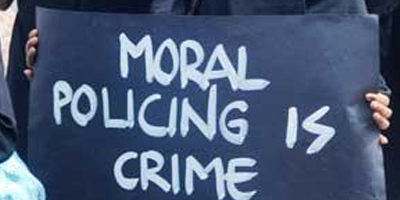
There is growing consensus among the scholars and activists of modern policing that ‘moral policing is a crime’. Hardly anyone related to the profession or apart can disagree this. In its deeper and literal sense, a police officer is expected to discharge his duties that the law, not morality, expects and mandates him or her under the oath to perform.
Behind any law stands the state which owns it and constructs sanctions behind the law by making it clear to its citizenry that any violation of law has its consequences for the violators. Enforcing morality is not mandatory for any police organisation, though sometimes facilitating it brings good name to police but only in some parts of the world, so it cannot be said to be universally true.
The law is a citizen-state affair, while morality is individual’s personal matter partially with society and culture and primarily between God and humans. The state is not a divine institution; it is a man-made phenomenon developed by humans for peace and progress while living in a society. However, things divine do have their consequences for the life after death. The major sources of the morality are divinity and revelations. Here comes the role of religion in human life. There are many religions which mankind practice with one central commonality and that is the concept of Godhead and life after death.
Religion defines the human relation with God. Its teachings make its adherents aware of the consequences of not abiding by the commandments of God. This does have technical and corresponding impacts on how humans build their concepts and sketch the images of the state and its inherent sovereign power. According to some religions including Islam, the sovereignty belongs to God. God gives sovereignty to the state for the running of the worldly affairs. There are others who contradict this point of view of state sovereignty. According to them, sovereignty belongs to the people who entrust it to the state through their elected governments who make laws, not code morals, for the well-being of the society. Morality becomes less relevant to law and politics in modern-day contexts.
However, Policing is a pure part of law and politics. Policing is a worldly activity which cannot claim any otherworldly responsibilities or consequences except the individual faith of a police officer for having consequences for him or her of the acts he or she performs in the capacity of being a police officer. This is optional and varies from one person to the other even if they belong to the same religion.
Law of the state mothers the police. The origins of police lie entangled in the wish of the rulers to control their populations who they feel could deprive them of their right to rule the people without any question raised or any finger pointed against them or against their rule. As a result of the police invention for controlling the socially uncontrolled and politically disobedient people, the police emerged as a force model with the notoriety of coercion, highhandedness, torture, and inhuman behaviour.
This aspect of the origin and standing of police as law enforcing agency bring home the fact that the police are for the rule of law. It matters least what is the source of law, either the words of the king or a piece of legislation by the publically elected legislature. State pay police for being loyal and sincere to the integrity of the state and security of its order.
However, the changes in the state citizenry relationships in the aftermath of the French revolution and American war of independence during the second half of the 18th century have redefined the way police is supposed to be the blind follower of state maximums. Now the democratic world has offered police a golden opportunity to define their role and mandate as the unbiased and impartial protectors of public rights, liberties, properties and life.
During the times we are living, the police claim to be a public service with the clear mandate to uphold the rule of law according to which the remedies against the violations of fundamental rights of the people are constitutionally available even against the state. The Democratic order claims to have stricken a beautiful balance between the individual liberty and the state authority, minimising anarchy as well as tyranny.
Policing democracies is bit different and difficult in comparison to policing tyrannies in authoritarian societies. Policing a society where public know the value of their single vote which really matters a lot beyond any shadow of doubt call for excellence in police professionalism and practical work. In such environs cops working according to their emotional undertones are bound to surface as biased in terms of gender, ethnicity, race, religion, region, ideology, colour, language, culture and so on; his or her prejudices predominate his professional work and burn his or her potentials for building peace in the society.
The police officer is a law officer, therefore. He should stay away from being an emotionally charged entity which brings nothing but disaster to all. In this age of information anarchy, nothing is hidden from the eye of media and people are well aware of their rights of privacy and freedoms. Making searches of who is dating with whom and who is in love relations with whom or who is earning how much and why or who drinks and who does not are something that divert police focus on order, security, safety, and other law enforcement duties, waste the precious time of officers, get officer into unnecessary arguments, and also tarnish the image of police as helpers and protectors.
There is no harm if police officer stops drunk drivers for his or her own benefit and safety. It becomes a legal action, not because of driver drinks but because he drives drunk. Therefore, if he or she drinks it is a moral domain which converts into the legal arena when a drunk person drives because the law does not allow him or her to drives in such a condition due to safety rules and hence try to protect drunk driver to fall.
In the light of above analysis, moral policing is, indeed, a marked departure from primary professional duties of law enforcement and tend to create more problems for the police officer on duty as well as for the public persons who he or she deals with. Therefore, moral policing is a deviance which in many cases qualifies to be a crime but may or may not be a sin! However, the police officer must choose what our law of the land expect us to do in the capacity of being the law enforcers in the best interest of the public.

 Vision-Vista of JJ Baloch
Superb 👍🏼
LikeLiked by 1 person
If a man is leveled fake-allegations by an influential person and the poor man fails to prove his innocence for any reason then what should be the role of police to tackle such case?
Likewise, if an innocent man is presented in a court before the jury, but he has no any evidence to prove his innocence. On the other hand, the influential party has many copies of evidence;even though he is guilty. What do you think, either the court give decision in favor of the poor morally or should consider law superior?
LikeLike
In this regard, justice Durab patel said in the court, “We are courts of law; we are not courts of conscience”. Here only evidence can create impact because without that only reason and not emotion can dominate and dictate the decision of the court. if truth is diffict to be proved in whatsoever way, the facts established can preval because it is not the “should be” which matters in jurisprudence but rather it is the “is-ness” of the matter which takes the lead. This is how it is and this is not what it should be. Therefore…….JJB
LikeLiked by 1 person
Rightly put sir! Morality, like religion, is a personal matter, someone’s personal space is inviolable just as religious rights are inviolabe. Moral policing has done police more harm than good.
LikeLike